Logo Glasso United Kingdom

PERSONALIZED ELEGANCE: CUSTOM AWARDS, CRAFTSMANSHIP AND EXCELLENCE

    Our Wikipedia: glass cutting technologies

    a) Waterjet
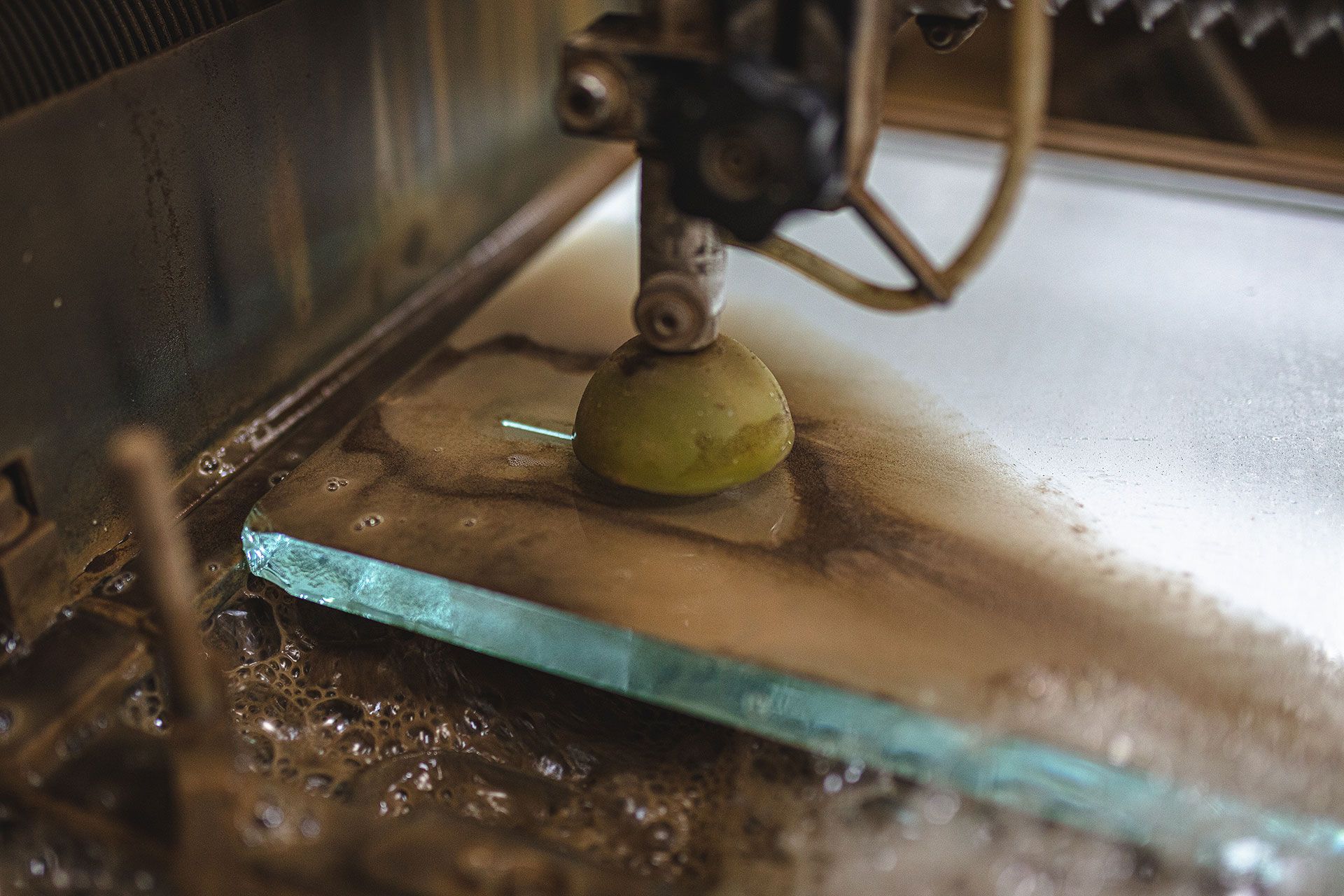
    waterjet

    This technology is used for cutting glass with complicated shapes. Thanks to it, even the most imaginative projects for our customers can be cut out. It is suitable for cutting thin glass panes. TECHNOLOGY:

    As the name suggests, cutting is carried out using a high-pressure water jet, to which abrasive material is added in the final stage of flow. Water and abrasive material are fed through a system of pipes to a nozzle, from which their mixture emerges, creating a cutting stream. It has sufficient energy to cut not only glass but also hard metals. The system of moving the cutting head along the worktable is analogous to that of CNC milling machines.

    The edge of the glass after water cutting is uniform and matte - ready for further processing.

    b) Cutting with a knife

    The simplest glass cutting technology. It is only used for thin glass sheets. The disadvantage of this technology is its accuracy and the quality of the edges.

    Cutting with a knife is performed using a specialized glass cutting tool. It is used to make a score - a scratch on the surface of the glass - in the planned cutting area. Then, the cut piece is broken off. As a result, the edges may be chipped in some places.

    The edge of the glass after cutting with a knife almost always requires further processing, aimed at blunting the sharpness and obtaining aesthetic edges.

    c) Cutting with a saw

    Cutting with a saw is used when the material to be cut is thicker than a few millimeters. It can be successfully used even for crystal blocks characterized by a thickness of several centimeters.

    In this technology, we use a specially prepared saw with a large and stable cutting blade (any significant vibrations can lead to glass cracking during cutting). Additionally, water is supplied to the cutting area to cool both the blade and the material being cut. Overheating of either of these elements can lead to uncontrolled glass cracking. After cutting with a saw, we obtain a flat but rough surface. Further processing is necessary, from grinding to polishing.